If you are anything like me, your bedroom currently has a designated “Purgatory Chair.”
You know the one. It’s not for sitting. It’s for the pile of clothes you’ve mentally evicted from your wardrobe but haven’t actually physically removed yet. Maybe they are waiting to be photographed for Vinted. Maybe they are already sold and waiting for you to find a printer that actually works so you can ship them.
The side hustle of reselling clothes is great. It’s sustainable, it clears space, and it buys you coffee.
But the logistics? The logistics are a nightmare.
The “Did I Sell That?” Panic
Here is a scenario I’ve lived through one too many times:
I’m looking for my favorite denim jacket. I tear apart my closet. I check the coat rack. I check the trunk of my car. Then, a faint memory surfaces—did I sell that on Depop three months ago? Or did I donate it? Or is it just lost?
When you’re actively cycling clothes in and out (which we should be doing! Circular fashion for the win!), it is surprisingly easy to lose track of your own inventory.
Most “Power Sellers” use spreadsheets to track this. They have Excel sheets with columns for “Listing Price,” “Sold Price,” and “Status.”
I don’t know about you, but I refuse to use Excel in my leisure time. That is a boundary I am setting for my mental health.
Mark it ‘Sold’, Watch the Money Stack
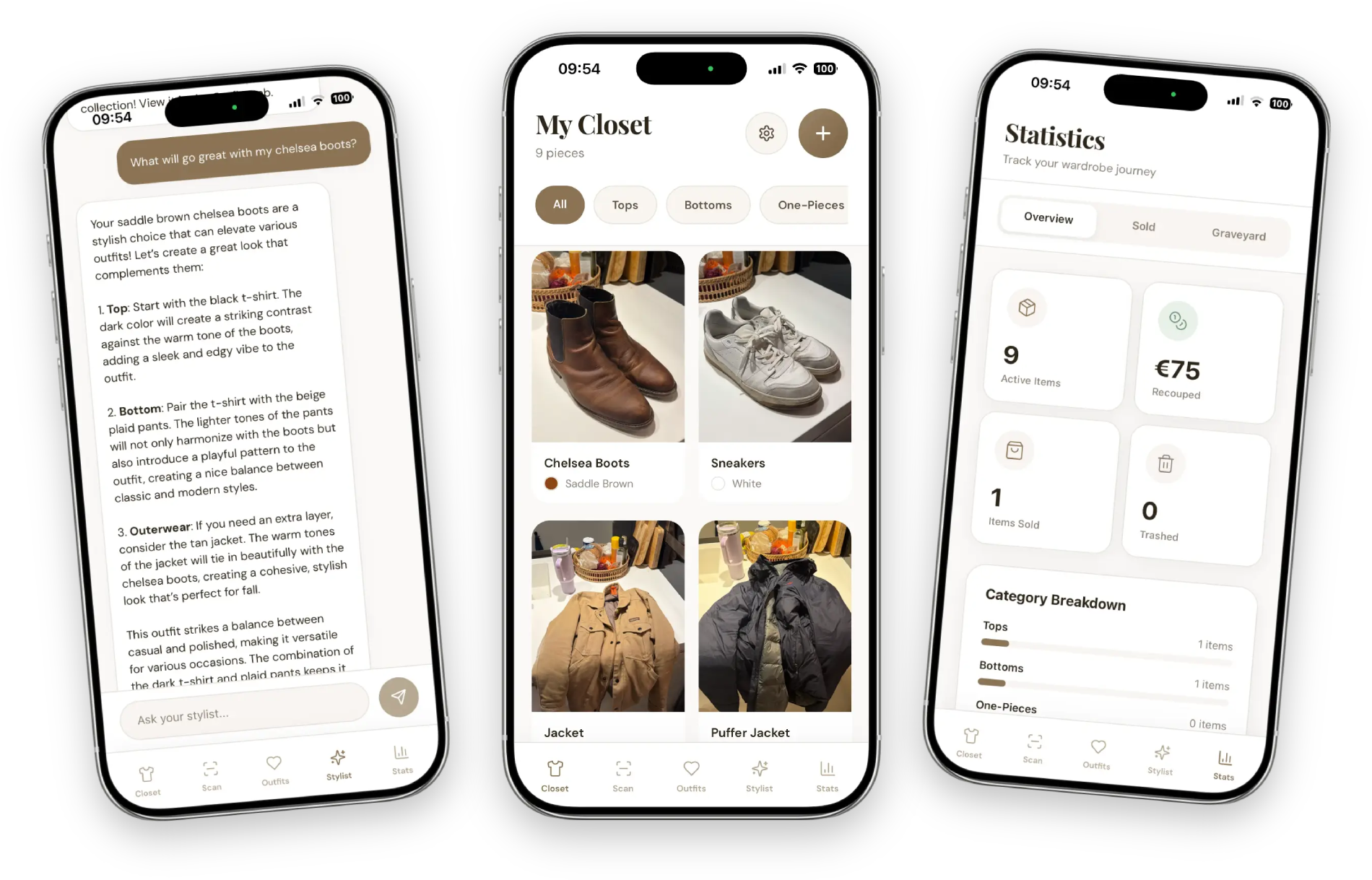
This is one of the weirdly satisfying features we built into ClosetGems.
Because you’ve already scanned your wardrobe into the app (thanks, AI auto-tagging), you have a digital inventory of everything you own.
When you finally sell that dress that’s been sitting on the Purgatory Chair, you don’t just delete it from the app. That feels anticlimactic.
Instead, you change the status to ‘Sold’.
It moves the item out of your active closet—so the AI Stylist stops telling you to wear it—and into your Sold History.
Why Keep a History? (Girl Math)
Why would you want to keep a record of clothes you don’t own anymore?
Two words: Girl Math.
(Okay, actual math, but let’s go with it.)
Seeing a visual list of everything you’ve sold is incredibly validating. You can scroll through your ‘Sold’ tab and see: “Okay, I got rid of 10 items this month. That cleared up space, and if I sold them for roughly $20 each… I basically made $200.”
It gamifies the decluttering process.
It also stops the seller’s remorse. You have a record of it. You know where it went. It didn’t just vanish into the abyss; it went to a new home (and funded your new boots).
The Graveyard of Good Intentions
We also have a status called ‘Moved to Graveyard’. This is for the stuff you donated, recycled, or—let’s be real—had to throw away because of an unidentifiable stain.
Tracking this stuff seems small, but it helps you understand your shopping habits.
If you look at your Graveyard and see that you’ve thrown away five cheap polyester tops in the last year, you might think twice before buying a sixth one. It’s a reality check on your consumption.
Clear the Chair
So, get those packages shipped.
Open ClosetGems, tap that satisfying ‘Sold’ button, and watch your active wardrobe shrink back to a manageable size.
Your Purgatory Chair is ready to be sat on again.